In standard quantum mechanics, the time-dependent Schrödinger equation describes how the wave function of a particle evolves in time:
i\hbar \frac{\partial \psi}{\partial t} = \hat{H}\psi
where (\psi) represents a probability amplitude — not a real field, but a statistical description of possible outcomes. In this view, the act of observation “collapses” the wave function into one result.
Khandro Field Theory (KFT) proposes a different picture. Here, the basic entity is not a probability wave but a real field phase (\phi_k(\mathbf{r},t)), representing continuous physical interference across space. Its evolution equation replaces the external potential (V) with the intrinsic gradient of the field density: \hbar \frac{\partial \phi_k}{\partial t} = -\frac{\hbar^2}{2m}\nabla^2 \phi_k + \alpha (\nabla \rho_k)\phi_k
In KFT, no collapse occurs — measurement simply introduces a local phase shift within the unified field. Photons, in this sense, “are not afraid of being watched.”
In short: in Newton’s view, gravity is a force between masses. In KFT, we speak of a local reaction to the gradient of the field’s density — without “action at a distance.”
Newton described gravity as a force acting between masses — mysteriously, “at a distance.” In his view, the Earth instantly affects every object within its reach. Although it was a revolutionary idea that explained planetary motion and falling bodies, the “force at a distance” itself remained an unresolved puzzle.
KFT (Khandro Field Theory) introduces a different approach: instead of a “magical force,” it speaks of local interaction with the Khandro field. Space is filled with Khandro particles that cluster around matter. Large bodies, such as the Earth, push out and organize these particles, creating a denser gravitational field. An object in such a field is not “pulled from outside” but experiences interaction internally, at the level of its atoms.
In practice, this means that KFT eliminates the need for action at a distance, providing a clear cause-and-effect: the greater the mass, the higher the field density, and therefore the stronger the interaction with surrounding objects. The “magic” of instantaneous action across infinite space disappears, replaced by a physical process — the interaction of matter with the external Khandro field. The field originates externally (e.g. from the Earth) but acts locally on each particle of matter inside the object. This opens a new way of looking at cosmic phenomena, from planetary motion to galactic dynamics.
Gravity according to Newton
Every body with mass attracts other bodies. The force grows with the masses and decreases with the square of the distance. We write it as: F = G \frac{m_1 m_2}{r^2}
where F is the gravitational force, G is the gravitational constant, m_1 and m_2 are the masses of the bodies, and r is the distance between them.
On Earth we get an acceleration of about: g \approx 9.81 ,\text{m/s}^2
and planets orbit because gravity “pulls” them inward while their forward motion prevents them from falling straight down. The conceptual weakness is that in the classical version it looks like “action at a distance,” with a force that decreases like \propto 1/r^2.
Gravity in KFT
Instead of a force at a distance, we have an energy-density field (the Khandro field), and a body responds locally to the gradient of that density.
The simplest expression is: a_r = – \frac{ \partial_r \rho_k }{ \rho_{kw}, \mathcal{K} }
meaning that acceleration toward the “denser” region of the field is proportional to the local gradient (the derivative with respect to r), scaled by inertial constants.
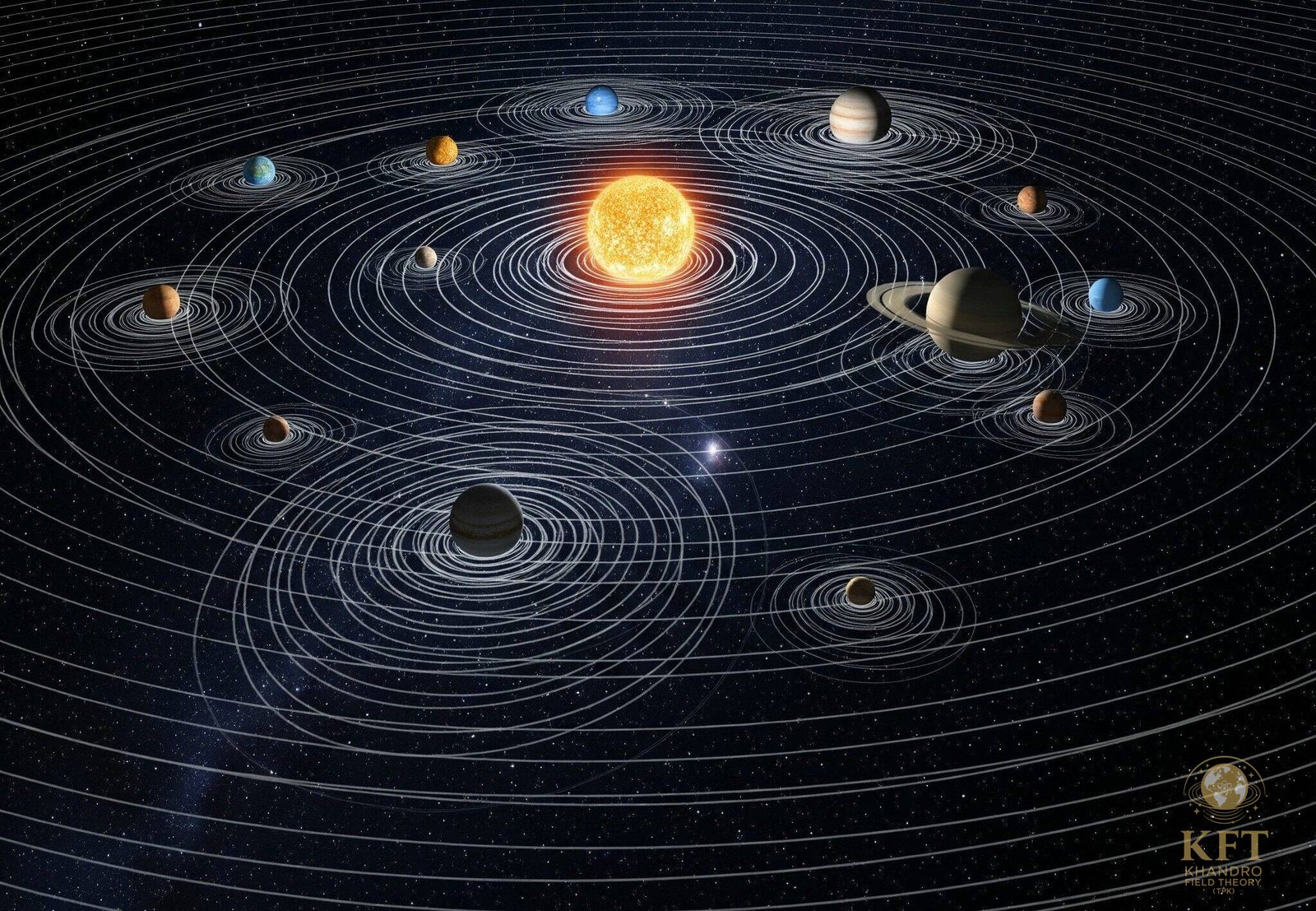
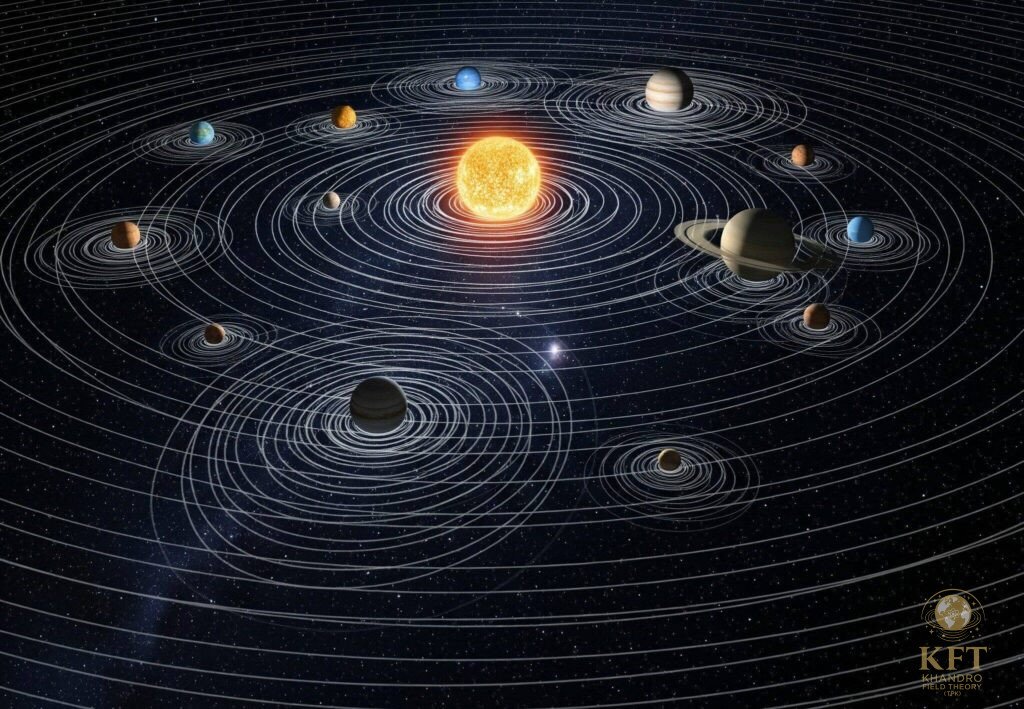
Intuitively: the apple falls because just “below it” the field is slightly denser than “above it”; a planet maintains orbit because the density profile around the Sun balances its forward motion.
We gain full locality and causality (changes propagate at finite speed), and in simple conditions the numerical results match classical gravity; differences appear only in subtle effects.
Numerical examples
Newton (for comparison)
Near Earth’s surface: – free fall acceleration g \approx 9.81 ,\text{m/s}^2 – force on 1 kg: F = mg \approx 9.81 , \text{N}
In low Earth orbit (~400 km altitude): g(r) = \frac{GM_\oplus}{r^2} ;;\Rightarrow;; g \approx 8.69 ,\text{m/s}^2
Orbital velocity: v = \sqrt{\frac{GM_\oplus}{r}} \approx 7.67 ,\text{km/s}
KFT – connecting it to numbers
Assume the simplest density profile around a central mass: \rho_k(r) = (\rho_{kw,K}) , \frac{GM}{r}